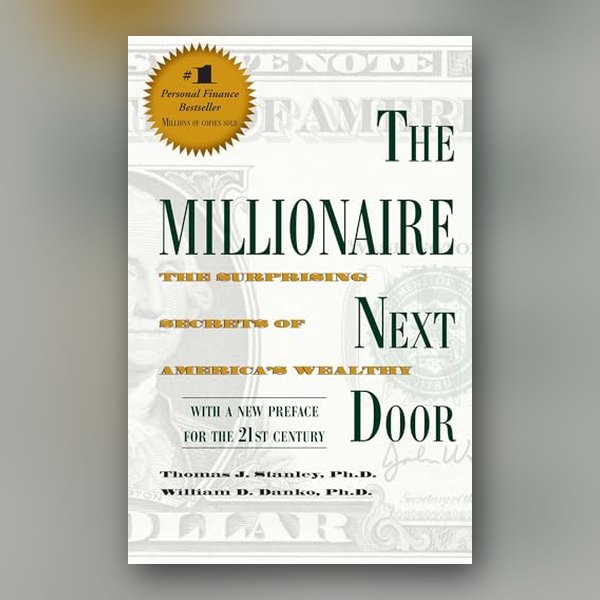
Episode-by-episode discussion of The Millionaire Next Door by Thomas J. Stanley and William D. Danko — who actually gets rich in America, and why the big house was never the signal. Each episode takes one chapter and turns it into something you can use today. Part of Money Podcast.
One chapter per episode, in the book's own order. Each episode stands on its own.
Stanley and Danko set out to study wealthy Americans and went looking for them in the upscale neighbourhoods where wealthy people obviously live. What they found broke the study and became the book. Many of the people in expensive homes driving luxury cars had very little actual wealth — and many people with a great deal of wealth were not living in those neighbourhoods at all. This opening episode lays out the distinction the whole book runs on, between a high income and a high net worth, and the seven characteristics that separate the two. It ends with the question the authors put to every reader: are you willing to make the trade-offs in time, energy and consumption that this actually requires? Many people conclude they are not.
They don't look like millionaires, dress like millionaires, eat like millionaires or act like millionaires. So where are the ones from the television version? This episode introduces the two categories that run through the rest of the book — PAWs, prodigious accumulators of wealth, and UAWs, under-accumulators — along with the formula the authors use to decide which one you are, based on your age and your income rather than your lifestyle. It covers who America's millionaires really are, the ancestry data the authors found most surprising, and why the self-employed are so heavily over-represented. It closes on Toddy, the inherited-wealth type who still talks about ancestors who founded steel mills and railroads, and who the authors consider an endangered species.
The authors booked gourmet food designers, four pâtés, three kinds of caviar, a case of 1970 Bordeaux and a case of 1973 cabernet sauvignon, then waited for their decamillionaire focus group. The first to arrive was a sixty-nine-year-old first-generation millionaire they nicknamed Mr. Bud, owner of several valuable pieces of New York commercial real estate and two businesses, wearing a well-worn suit. Offered the Bordeaux, he said he drank scotch and two kinds of beer: free, and Budweiser. This episode is the heart of the book — living well below your means, the budget most millionaires actually keep, and contrast cases like Mr. Petersen, a high-earning marketing manager in tech who never invested a dollar in a growth company.
Efficiency, the authors argue, is one of the most important components of accumulating wealth — and the people who build it allocate time, energy and money in ways that are conducive to building more of it. This episode is built on the comparison that makes the point sharpest: two doctors, Dr. North and Dr. South, with comparable incomes and wildly different outcomes. Nineteen issues were of high or moderate concern to one of them; only seven to the other, who consequently had far more time and energy left for wealth-building activity. The chapter is full of the hours-per-month data behind it, and ends with a deceptively practical instruction: interview several CPAs and choose the one whose client list has the highest concentration of PAWs.
Dr. W. W. Allan is a self-made multimillionaire who has lived in the same three-bedroom house in the same middle-class neighbourhood for nearly forty years. The principle he embodies is the chapter's subtitle: financial independence matters more than displaying social status, and most people quietly choose the opposite. This episode goes deep into the car data, which the authors use as the cleanest available measure of that choice — the buyer types, the dealership behaviours, and the price-prone shoppers who paid an average of $22,500 for their most recent vehicle. It ends on the contrast that defines the whole book: one man never bought an expensive car until after he was wealthy; Gary buys his in anticipation of a day that is unlikely ever to arrive.
The chapter opens with a letter: a couple writing in about an overdue trust the wife's parents will not release, and a mother-in-law who keeps putting them off. That is the subject — economic outpatient care, the ongoing cash gifts affluent parents give adult children, and the authors' finding that it reliably produces the opposite of what is intended. Recipients of substantial gifts accumulate less wealth than non-recipients in the same occupations, not more. This episode is about why subsidy suppresses the habits that build wealth, how adult children come to budget around money that isn't theirs, and the quiet observation the authors keep returning to: courage, discipline and resolve almost never show up in someone's appearance.
Most affluent parents want to reduce their estate before they die, which is sensible — the alternative is handing a large share to the tax authorities. The question is what the transfer does to the people receiving it. This episode covers the authors' rules for raising economically self-sufficient adult children, and the patterns they found in who receives what: unemployed adult children are more likely than their employed siblings to be given personal real estate, and the gift-and-inheritance data differs sharply by profession. It ends on the line that lands hardest — children sheltered from every conceivable difficulty were not protected. They were never inoculated against fear, worry and the feeling of dependency.
Why aren't you wealthy? Perhaps, the authors suggest, because you aren't pursuing the opportunities that actually exist. This episode is the most commercial chapter in the book: how to identify and target affluent markets, and specifically the services the wealthy and their heirs must buy regardless of the economy. The authors work through the estate-services numbers in detail — estimated fees, the predicted number and value of million-dollar-plus estates, and a state-by-state ranking. California has the largest millionaire household population outright; measured as concentration per 100,000 households, Connecticut comes first. It is a chapter about going where the money already is rather than waiting for it to find you.
The question the authors get asked more than any other is simply: who are the affluent? This closing episode answers it occupationally. Most of America's millionaires are not in the glamorous professions — they are in dull, normal, profitable businesses, and the authors rank the most profitable categories of sole proprietorship outright. It covers why the self-employed dominate the millionaire population, how heirs' career paths diverge from self-made millionaires', and what that means for anyone choosing work now. It ends with a story about a man who sold his units well below market value — several hundred thousand dollars lost — because a hostile environment, however beautiful the people in it, is no place to accumulate wealth.
We discuss it chapter by chapter, but nothing replaces reading it. This is an Amazon affiliate link — it costs you nothing extra and it helps pay for the show.
9 episodes in this show, 1,100+ across the whole network, and a new one every day.
More chapter-by-chapter shows: The Psychology of Money · Rich Dad Poor Dad · I Will Teach You to Be Rich · Think and Grow Rich · The Art of Spending Money
Educational commentary and review only — not affiliated with, endorsed by or sponsored by Thomas J. Stanley or the publisher. All discussion is transformative and used under Fair Use. No copyright infringement intended. As an Amazon Associate we earn from qualifying purchases.