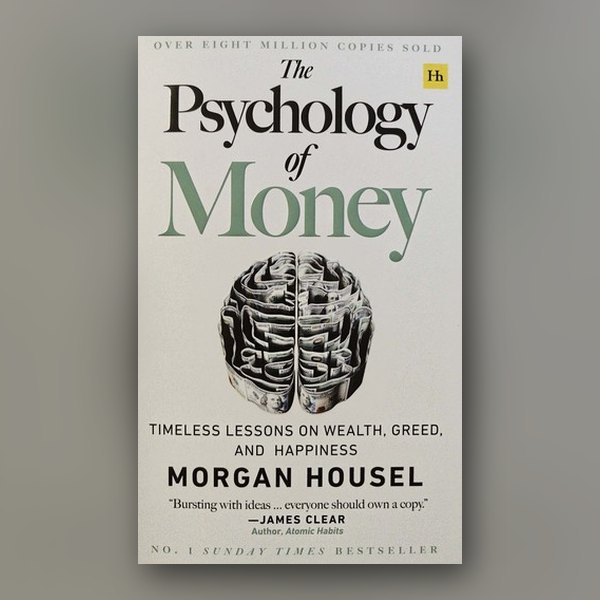
Episode-by-episode discussion of The Psychology of Money by Morgan Housel — luck, risk, compounding, and the wealth you never get to see. Each episode takes one chapter and turns it into something you can use today. Part of Money Podcast.
6 episodes listed below. All 22 are on Apple Podcasts, free, no signup.
Building wealth has little to do with your income or your returns and almost everything to do with your savings rate. Housel's proof is the 1970s oil crisis, which we escaped through efficiency rather than discovery — the US now uses 60% less energy per dollar of GDP than in 1950. Savings, he writes, is the gap between your ego and your income, so the fastest way to save more isn't a raise, it's humility. What savings actually buy is flexibility: the ability to wait, to retrain, to find your niche at your own pace while everyone else is forced to hurry.
You are not a spreadsheet, you're an emotional person — so aim to be reasonable, not coldly rational, because reasonable is what you'll actually stick with. Housel opens with Julius Wagner-Jauregg, who cured syphilis by deliberately infecting patients with malaria, as a lesson in bold versus crazy. Harry Markowitz, who won a Nobel for portfolio optimisation, split his own money 50/50 to minimise future regret. Even Jack Bogle, scourge of high fees, put money into his son's high-fee fund: "We do some things for family reasons. If it's not consistent, well, life isn't always consistent."
Stanford's Scott Sagan said it best: things that have never happened before happen all the time. History is mostly the study of surprising events, yet investors treat it as an unassailable guide — what Housel calls the "historians as prophets" fallacy. Geologists and doctors can trust historical data because kidneys work the same in 2020 as in 1020; markets are millions of people making imperfect decisions, so the events that move the needle most are the ones history never warned about. The further back you look, the more general your conclusions should be.
The smartest money behaviour Housel knows comes from blackjack card counters, whose whole edge rests on humility: they know the odds, not the outcome, so they never bet so heavily that one bad hand ends the night. He applies it to the 6.8% real average return of US stocks since the 1870s and all the what-ifs that number hides — a bear market landing on your retirement date, a medical bill in your 30s. The overlooked trick is saving with no specific reason at all, because no one knows their future expenses. The most important part of any plan is planning on the plan failing.
Housel's hardest-working friend spent 15 years fighting his way into medicine, then summed up the result in two words: awful career. Daniel Gilbert's research shows people from 18 to 68 consistently underestimate how much they will change, which quietly sabotages every long-term financial plan. Munger says never interrupt compounding unnecessarily — but how do you avoid interrupting it when what you want from life keeps moving? The answer is Daniel Kahneman's: "I have no sunk costs." Abandon goals your former self set, and get back to compounding sooner.
Everything has a price; the trouble is the price isn't obvious until the bill is overdue. General Electric was worth a third of a trillion dollars in 2004 and fell from $40 a share to $7, and Jeff Immelt's parting line was that every job looks easy when you're not the one doing it. Morningstar found that of 112 tactical funds built to dodge the 2010–11 turmoil, only nine beat a plain 60/40 portfolio — they wanted the return without paying for it. Market volatility is an admission fee, like Disneyland; treat it as a fine and you'll never enjoy the ride.
We discuss it chapter by chapter, but nothing replaces reading it. This is an Amazon affiliate link — it costs you nothing extra and it helps pay for the show.
22 episodes in this show, 1,100+ across the whole network, and a new one every day.
More chapter-by-chapter shows: The Art of Spending Money · Rich Dad Poor Dad · The Millionaire Next Door · I Will Teach You to Be Rich · Think and Grow Rich
Educational commentary and review only — not affiliated with, endorsed by or sponsored by Morgan Housel or the publisher. All discussion is transformative and used under Fair Use. No copyright infringement intended. As an Amazon Associate we earn from qualifying purchases.