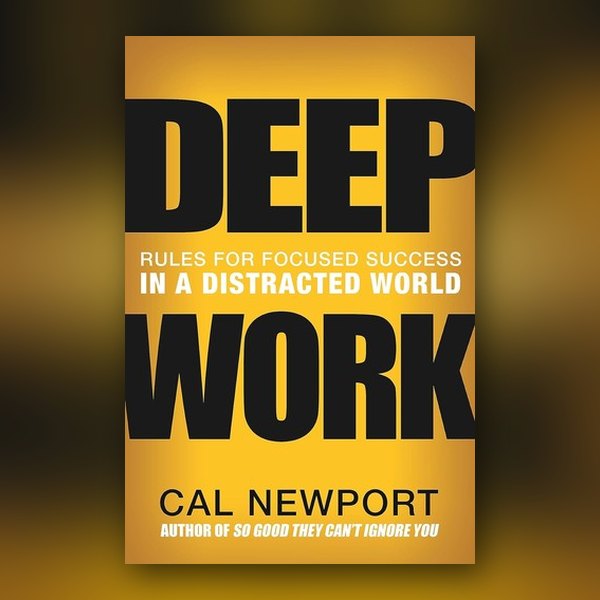
Episode-by-episode discussion of Deep Work by Cal Newport — why focused work is rare and valuable, and how to build a day around it. Each episode takes one chapter and turns it into something you can use today. Part of Booktok Podcasts.
One chapter per episode, in the book's own order. Each episode stands on its own.
We open with Newport's central claim: the ability to concentrate without distraction is getting rarer at exactly the moment it is becoming more valuable. We lay out what he means by deep work, how it differs from merely being busy, and why so many people finish a full day having produced almost nothing they would defend.
Newport argues that in an economy where machines handle the routine, the people who win are the ones who can master hard things quickly and produce at a high level. We walk through that argument, look at who it actually favours, and ask what it means if your job gives you no room to concentrate in the first place.
If deep work is so valuable, why does almost every workplace make it impossible? We go through Newport's answer — the pull of visible busyness, the metric black hole, the culture of instant replies — and talk about the uncomfortable fact that looking productive is often rewarded more than being productive.
This is the chapter where Newport stops talking about output and starts talking about meaning. We unpack the idea that what you pay attention to becomes your life, why depth feels satisfying in a way scrolling never does, and where the craftsmanship argument gets a little romantic about work.
The first and longest of Newport's four rules. We go through the different ways people structure deep work — the total retreat, the fixed daily block, the rhythm you can actually keep — and get specific about the routines, locations and rules that make focus happen without a daily act of discipline.
Newport's second rule is not about working harder but about retraining the reflex that breaks concentration before it starts. We look at scheduling your distraction instead of your focus, why boredom turns out to be the training ground, and the practices he suggests for rebuilding an attention span.
The most argued-over rule in the book. Newport asks you to judge each tool by whether its benefits outweigh its real costs, rather than keeping it because it has any benefit at all. We test that standard honestly, including on the people whose work or community genuinely lives on those platforms.
Shallow work is the email, the meeting, the status update — necessary in small doses and fatal in large ones. We cover Newport's tactics for shrinking it: budgeting your shallow hours, finishing at a fixed time, and writing replies that stop a thread instead of extending it.
We close the series by pulling the four rules back into one idea and asking what the book is really arguing for. Newport makes a case that depth is not just a productivity method but a way of living, and we finish by weighing what that asks of you against what it gives back.
We discuss it chapter by chapter, but nothing replaces reading it. This is an Amazon affiliate link — it costs you nothing extra and it helps pay for the show.
9 episodes in this show, 1,100+ across the whole network, and a new one every day.
More chapter-by-chapter shows: Slow Productivity · Atomic Habits · The Power of Habit · Stolen Focus · ADHD 2.0 · Dopamine Nation
Educational commentary and review only — not affiliated with, endorsed by or sponsored by Cal Newport or the publisher. All discussion is transformative and used under Fair Use. No copyright infringement intended. As an Amazon Associate we earn from qualifying purchases.