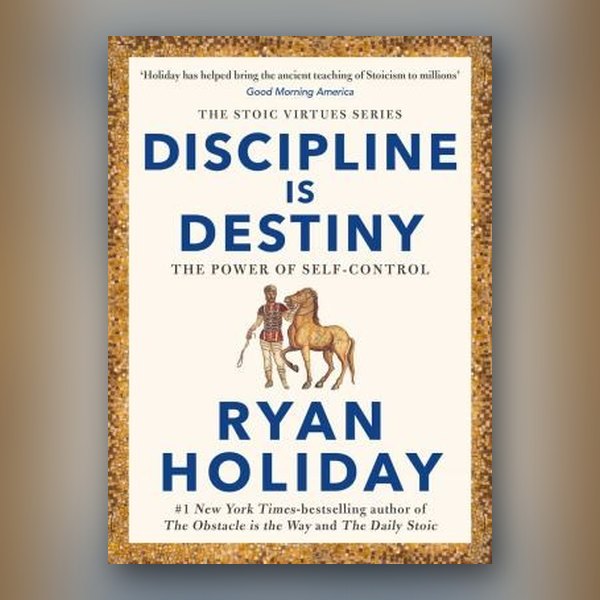
Episode-by-episode discussion of Discipline Is Destiny by Ryan Holiday — self-control as the Stoics taught it, through the people who got it right or badly wrong. Each episode takes one chapter and turns it into something you can use today. Part of The Grit Podcasts.
One chapter per episode, in the book's own order. Each episode stands on its own.
Before the twelve labours, before any of the fame, Hercules came to a quiet intersection in the hills of Greece. One goddess, dressed in finery, promised a life of ease and every desire filled. The other, in a plain white robe, promised nothing except what hard work earns: a long journey, sacrifice, frightening moments, and a life fit for a god. He hesitated for a second and took the second road. Virtue, in Greek, is arete, and it translates to something very simple. Excellence.
Lou Gehrig played 2,130 consecutive games for the Yankees, through fevers, migraines and crippling back pain, and once suited up the day after an eighty-mile-an-hour fastball hit him in the head, wearing Babe Ruth's cap because the swelling meant his own would not fit. Seventeen years, April to October, some 350 doubleheaders, at least two hundred thousand miles by train and bus. He had broken nearly every finger on both hands and had never said a word about it.
Toni Morrison woke before the sun, made the first cup of coffee and wrote while the light came up, a single working mother of two small boys with a day job editing at Random House. "It's not being in the light," she said, "it's being there before it arrives." By the evening she was burned out and too tired to think. The hours between the parting dark and the rising dawn were the only ones in which she was a writer, so she took them.
King George IV breakfasted on two pigeons, three steaks, most of a bottle of wine and a glass of brandy, and grew so heavy he could no longer sleep lying down without the weight of his own chest on him. He had a stamp made so he would not have to sign his name. Babe Ruth's day ran to eight hot dogs, eight bottles of Coca-Cola and four porterhouse steaks, and he was once hospitalised for precisely that. Fun going down. Bitter afterwards.
By 1949 Dwight Eisenhower had landed at Normandy, occupied Germany, published his memoirs and made a fortune. What was left was himself. He had smoked three to four packs a day for thirty-eight years, stopped cold, and never touched another cigarette. "The only way to stop is to stop," he told an aide, "and I stopped." The same year, Richard Feynman noticed a pull toward a drink that had nothing to do with reward, and gave up alcohol on the spot.
Manius Curius was at the height of his power when men arrived with money for him. They found him in his kitchen over a pot of turnips and knew instantly the errand was pointless: a man satisfied with so little can never be tempted. Cato the Elder lived the same way, wearing clothes worth a few coins and drinking the same wine as the people he worked the fields beside. "Nothing is cheap," he said, "if it is superfluous." The point was never deprivation. It was that nobody had any leverage on him.
We discuss it chapter by chapter, but nothing replaces reading it. This is an Amazon affiliate link — it costs you nothing extra and it helps pay for the show.
6 episodes in this show, 1,100+ across the whole network, and a new one every day.
More chapter-by-chapter shows: The Obstacle Is the Way · Atomic Habits · The Power of Habit · Deep Work · Stolen Focus · ADHD 2.0
Educational commentary and review only — not affiliated with, endorsed by or sponsored by Ryan Holiday or the publisher. All discussion is transformative and used under Fair Use. No copyright infringement intended. As an Amazon Associate we earn from qualifying purchases.