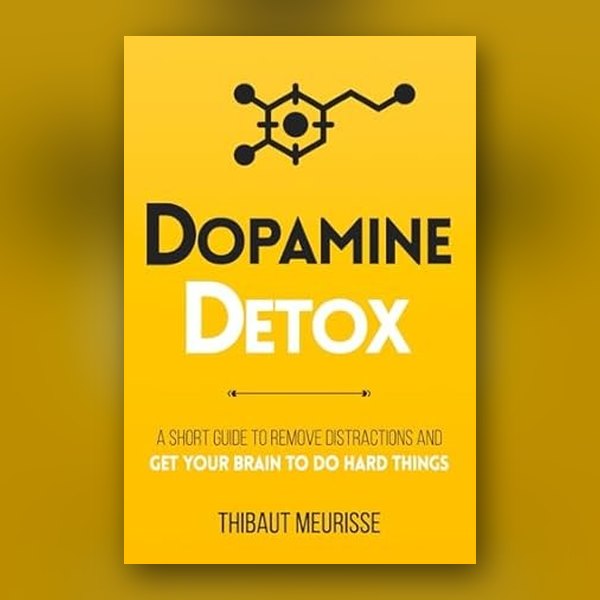
Episode-by-episode discussion of Dopamine Detox by Thibaut Meurisse — why your attention is shot, and the short reset that brings it back. Each episode takes one chapter and turns it into something you can use today. Part of Atomic Podcasts.
One chapter per episode, in the book's own order. Each episode stands on its own.
Do you keep putting off the jobs that matter? Feel restless and unable to settle on the task in front of you? Struggle to get excited about the goals that would actually change your life? Meurisse opens by naming the problem precisely, and it is not laziness. Dopamine is not the pleasure chemical most people think it is — it is the anticipation chemical, the one evolution built to make you chase things, and it worked beautifully when the things worth chasing were food and shelter. This first episode explains what dopamine is actually for, why that system has been hijacked in the modern world, and what you are really asking for when you reach for your phone.
This is the inventory episode, and it is uncomfortable. Every time you check email, check your stats, open YouTube, open a social app, or reach for something sweet, you are taking a small hit of a system that was never designed for infinite supply. Meurisse walks through each trap in turn and explains the mechanism behind it — including the honest version of the sugar question, where he cites the research that humans crave sugar and fat naturally but do not get opiate-style withdrawal from cutting them. The chapter closes on the hamster wheel most people live inside: one more coffee, one more email, work can wait, and hours disappear.
Once your level of stimulation rises, ordinary work starts to feel unbearably dull — and your mind defends the habit with four specific arguments. Trick one: going back to work will be easy, so a few more minutes won't hurt. Trick two: you can do it later. Trick three: excitement is the same thing as fulfilment. Trick four: you're missing out, and this opportunity is limited. Meurisse names each one so you can catch it in real time, and ends with a self-scoring exercise — rate each trick one to ten for how exactly it describes you. Five years of accomplishing almost nothing is built out of these four sentences.
A dopamine detox is not a mystical cleanse and Meurisse is clear about that. It is a deliberate reduction in stimulation so that ordinary, valuable work stops feeling boring by comparison. This episode lays out the three versions and who each one is for: the 48-hour complete detox, the 24-hour detox, and the partial detox that targets only your worst offender. It also answers the question everyone asks next — if I cut social media, sugar, processed food and video games, what am I supposed to do instead? The list is deliberately unexciting: contemplative walks, journalling, meditating, practising something. That dullness is the point.
The method, in full, and it takes three steps. Step one: identify your single biggest distraction rather than trying to quit everything at once. Step two: add friction — make the behaviour physically harder to start, because willpower loses to convenience every time. Step three: begin first thing in the morning, before the first hit has set the tone for the day; Meurisse is direct that what you do in your first waking minutes decides whether you are distracted all day. The second half is the part most people skip: what to do with the quiet. Take notes, reflect on your goals, audit your time, solve your actual problems, and write down the fears you have been outrunning.
A detox lowers your stimulation; this is what you do with the motivation it gives back. Meurisse's planning method is deliberately small — plan the day the night before, and schedule exactly one major task to work on each morning, chosen on three criteria: focus, consistency and impact. The tasks you avoid are not avoided because you are lazy, they are avoided because they are hard, unclear or boring, and the detox is what makes them tractable. This episode also gives his definition of productivity, which is narrower and more useful than the usual one: consistent focus on your most impactful tasks, and nothing else counts.
Forty-five minutes of genuine daily focus on your key task will out-produce almost anything else you do — and Meurisse gives five rules for getting it. Same place, same time every day. Choose a trigger. Get started before you feel ready. Eliminate distractions physically rather than by resolve. Work without interruptions. The second half introduces the idea that quietly explains most lost days: open systems. An open tab, an unanswered message, a decision you've left hanging — each one is a door your attention keeps walking back through. One tiny decision to close a system can change the whole day's output.
You finished the detox, you feel calmer and more in control — and old habits die hard. This closing episode is the maintenance plan: notice the earliest signs of relapse, understand the battle between you and your own mind, accept that the world is commercially against you, prepare a contingency plan before you need it, and put a sustainable system in place rather than relying on resolve. The sixth defence is the one that lasts — cultivating the here-and-now neurotransmitters through meditation, stretching, mindfulness, contemplative walking, deep conversation, and deliberate boredom. It ends with a 30-day challenge and a blunt instruction: stop letting your environment hijack your brain.
We discuss it chapter by chapter, but nothing replaces reading it. This is an Amazon affiliate link — it costs you nothing extra and it helps pay for the show.
8 episodes in this show, 1,100+ across the whole network, and a new one every day.
More chapter-by-chapter shows: Atomic Habits · The Power of Habit · Deep Work · Stolen Focus · ADHD 2.0 · Dopamine Nation
Educational commentary and review only — not affiliated with, endorsed by or sponsored by Thibaut Meurisse or the publisher. All discussion is transformative and used under Fair Use. No copyright infringement intended. As an Amazon Associate we earn from qualifying purchases.